Taste in the AI Era

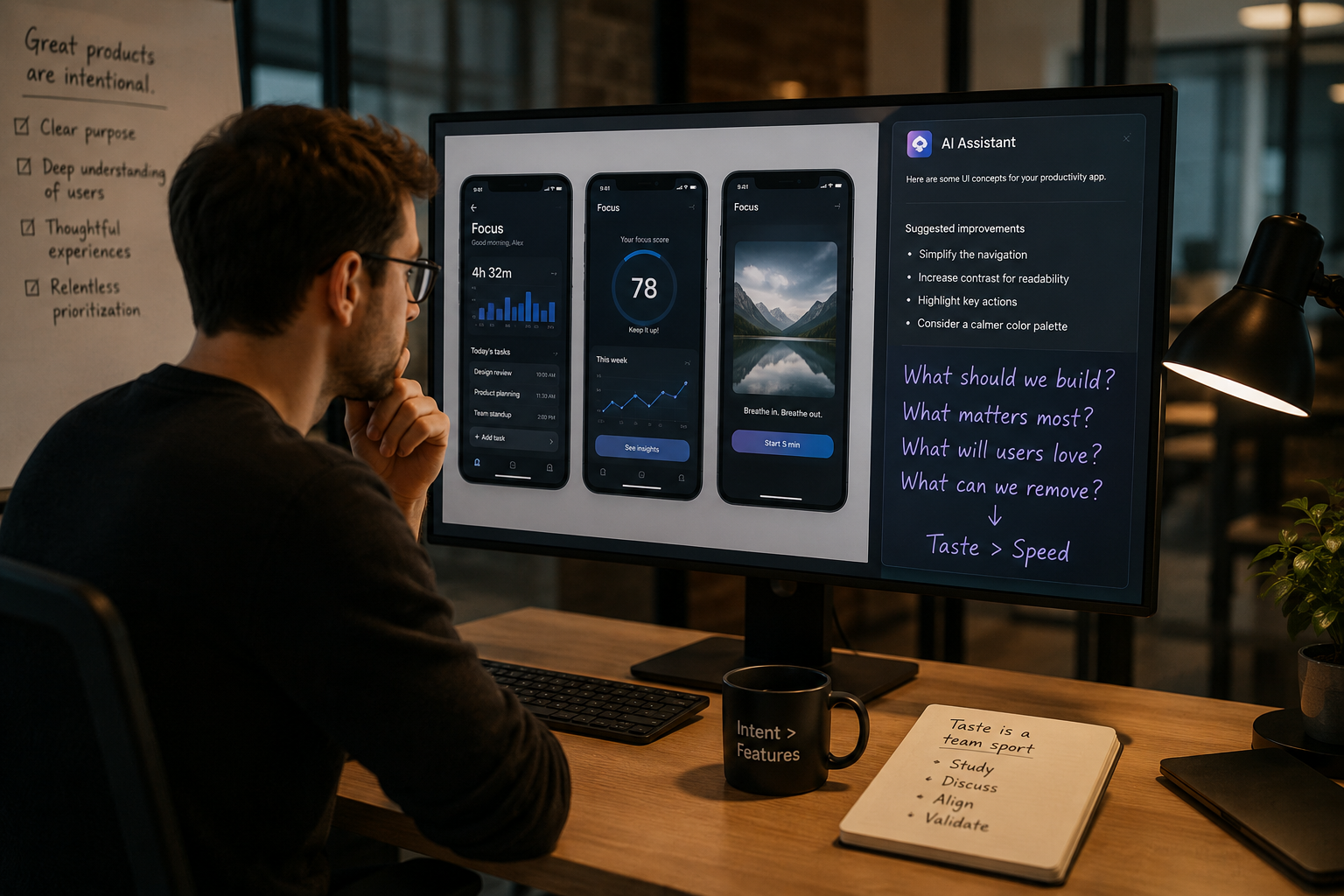
If you look at how software is being built today, one thing is becoming increasingly clear: we are no longer limited by execution speed.
With modern tools and AI-assisted development, teams can build prototypes in hours, generate interfaces instantly, and automate large parts of what used to be time-consuming engineering work.
And yet, despite this acceleration, one question is becoming more important than ever: If building is easy, why do so many products still feel average?
The answer is not execution. It is taste.
What “taste” actually means?
In product development, taste is often misunderstood as subjective preference or aesthetic judgment. In reality, taste is something far more practical: the ability to consistently make good decisions about what to build, what to simplify, and what to leave out.
Taste shows up in small but critical choices:
- how an onboarding flow feels in the first 30 seconds
- whether an interaction reduces or increases cognitive load
- whether a feature feels intentional or just added
- whether a product feels coherent or fragmented
Two products can solve the same problem with equal technical correctness, yet feel completely different in quality. That difference is almost always taste.
AI raises the floor, not the ceiling
AI is extremely effective at generating “reasonable” outputs. It can produce working code, design layouts, and complete workflows that appear correct and usable.
However, what it produces is typically:
- safe
- familiar
- pattern-based
- averaged from existing solutions
In other words, AI optimizes for what is most likely, not what is most intentional.
This is useful for speed, but dangerous for product direction. Without strong human judgment, teams can easily end up with systems that work technically but lack clarity, focus, and emotional quality.
Why taste is becoming the real bottleneck?
When building software was slow and expensive, constraints naturally forced prioritization. Now that building is fast and cheap, the constraint has shifted: The hardest problem is no longer “can we build this?” but “should we build it this way at all?”
This is where taste becomes critical. It acts as a filter. It prevents products from turning into collections of features that lack coherence, and it helps teams decide what truly matters and what creates unnecessary complexity.
Without it, speed leads to noise rather than progress.
Taste is not innate, it is developed!
A common misconception is that taste is something people either have or don’t have. In practice, taste is a learned skill. It develops through:
- studying well-designed products closely
- understanding why certain decisions feel right
- reflecting on user behavior and real outcomes
- repeatedly evaluating and refining judgment
Over time, teams build a mental library of patterns what good feels like, and what doesn’t work in practice.
Taste is a team capability, not an individual trait
Taste is often associated with strong designers or experienced product leaders. But in reality, its impact only becomes meaningful when it is shared across a team.
Without a shared language, taste becomes fragmented:
- one person says “this feels heavy”
- another says “this is fine”
- decisions become subjective rather than consistent
When teams develop a common vocabulary for quality terms like clarity, friction, weight, and flow taste becomes operational. It can be applied consistently across design, engineering, and product decisions.
The real risk in the AI era
The biggest risk is not that teams will build things too slowly. It is that they will build more things without stronger judgment behind them.
In that world, products can become:
- feature-rich but unclear
- functional but uninspiring
- fast to ship but slow to improve
Over time, users do not reject these products because they are broken. They leave because they do not feel coherent or intentional.
That is a taste problem, not a technical one.
The Bottom Line
AI is transforming how software is built, dramatically increasing the speed of execution. But it does not answer the more important question: What is worth building, and how should it feel when it exists?
That question is not becoming less important. It is becoming the defining skill of modern product teams.